Global Mobile Frequency Bands Reference (IoT Card / Module Selection Edition)
Organize LTE and 5G NR frequency bands by region, clarifying the three-layer relationship between technology standards, band allocations, and network deployment. Outline the verification sequence for NB-IoT, NSA networking, authentication, and SIM card form factors to help cross-border device manufacturers avoid band mismatches during the selection phase.
A 4G module that tested normally in China frequently reconnected after being installed on vending machines exported to Europe, despite detecting signals. Replacing the SIM card did not resolve the issue. The root cause is rarely the SIM; it's almost always a band mismatch. Bands are defined by the module's RF hardware capabilities—the SIM can only select networks within that range. Overlooking a single band verification during the selection phase often leads to costly downtime and troubleshooting in the field.
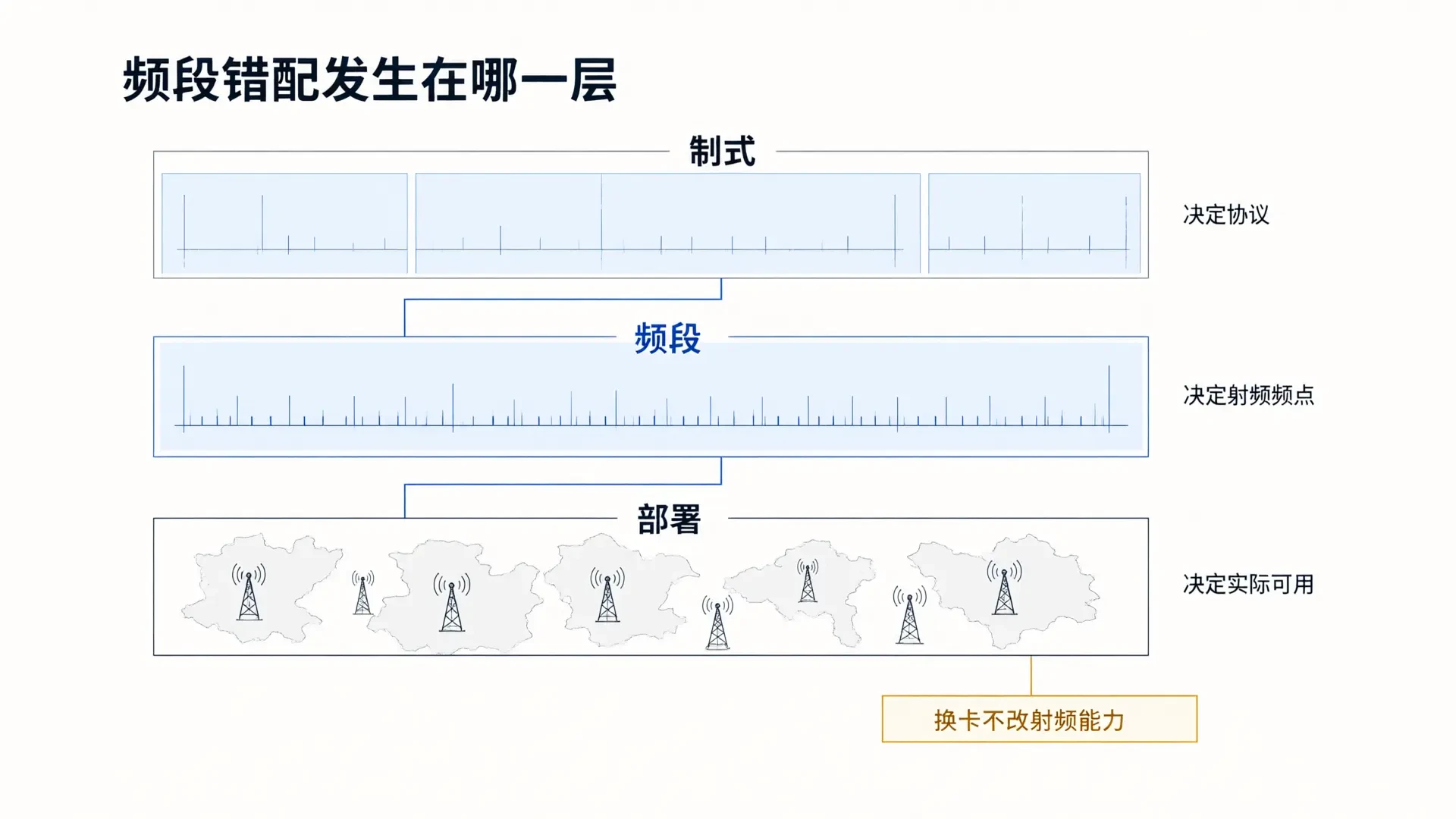
Distinguish between standards, frequency bands, and deployment.
The radio standard determines protocol capabilities and boundaries. LTE Cat.1 targets mid-to-low data rates for cost-sensitive devices; Cat.4 offers higher bandwidth; NB-IoT trades narrowband for ultra-low power consumption and deep coverage; 5G NR delivers high bandwidth and low latency. A single device cannot cross standard boundaries simply by swapping its SIM card.
Frequency bands are RF channel numbers defined by 3GPP. LTE uses the B series, while 5G NR uses the n series; these two systems operate independently. A module marked as supporting B3 does not automatically support n3. When purchasing, "multi-band" descriptions only have meaning when tied to specific band numbers. Deployment involves a separate consideration: just because a country has allocated a certain frequency band does not mean every local operator has already deployed IoT services on that band.
Frequency distribution in the main region
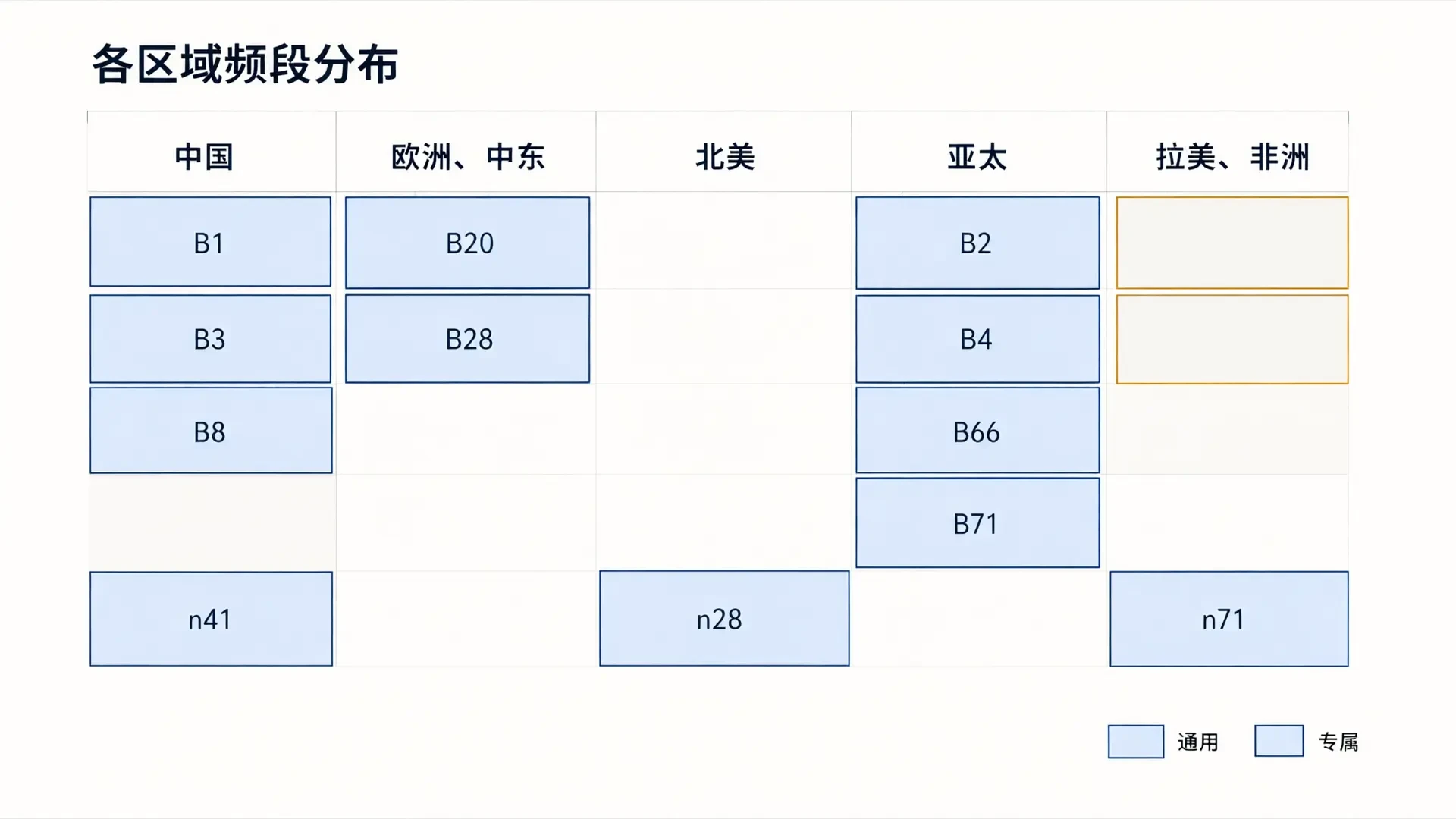
The table below lists common numbering schemes from public band plans by region for preliminary screening; this does not replace carrier-level validation.
| Region | Common LTE Frequency Bands | Common 5G NR Frequency Bands |
|---|---|---|
| China | B1、B3、B5、B8、B34、B39、B40、B41 | n41, n78, n79 |
| Europe, Middle East | B1、B3、B7、B8、B20、B28 | n1, n3, n28, n78 |
| North America | B2、B4、B5、B12、B13、B17、B25、B66、B71 | n2, n5, n41, n66, n71, n77 |
| Other Asia-Pacific regions | B1、B3、B8、B18、B19、B28、B40、B41 | n1, n3, n28, n41, n78 |
| Latin America, Africa | B2、B3、B4、B5、B7、B8、B28 | n3, n28, n78 |
The table shows two patterns. Bands B1, B3, and B8 have high cross-regional coverage, spanning Europe, Asia-Pacific, and parts of Latin America. In Europe and its surroundings, bands B20 and B28 are frequently used; devices lacking these bands will show significantly degraded indoor and suburban coverage once deployed in Europe. North America follows a different set: B2, B4, B12, B13, and B66 overlap little with European bands. Devices designed solely for European bands typically rely on roaming when entering the North American market.
Additional Variables for NB-IoT and 5G
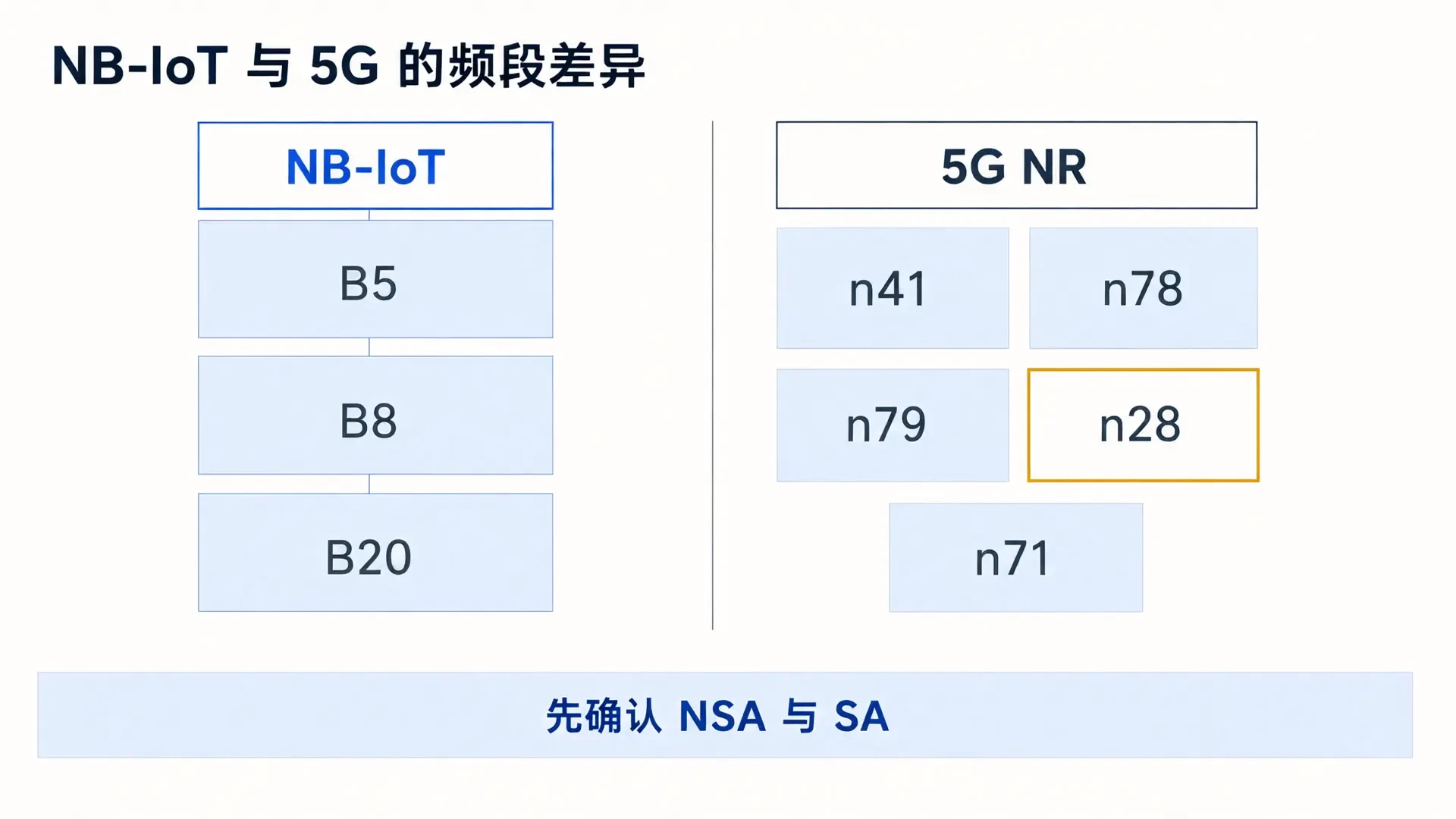
NB-IoT operates on more concentrated frequency bands than LTE. In China, Bands 5 and 8 are dominant; in Europe, Bands 8 and 0 are common. When developing export products like water or gas meters, verify the NB-IoT band list for the module separately—do not assume it matches the 4G module configuration.
5G requires confirmation of the network architecture. n41, n78, and n79 are the primary bands in China; n28 provides wide coverage in Europe; and n71 is used for low-band coverage in North America. Some overseas operators have stopped adding new NSA connections. Modules supporting only NSA will lose 5G capability in those regions and revert to LTE.
From Frequency Bands to Selection Conclusion
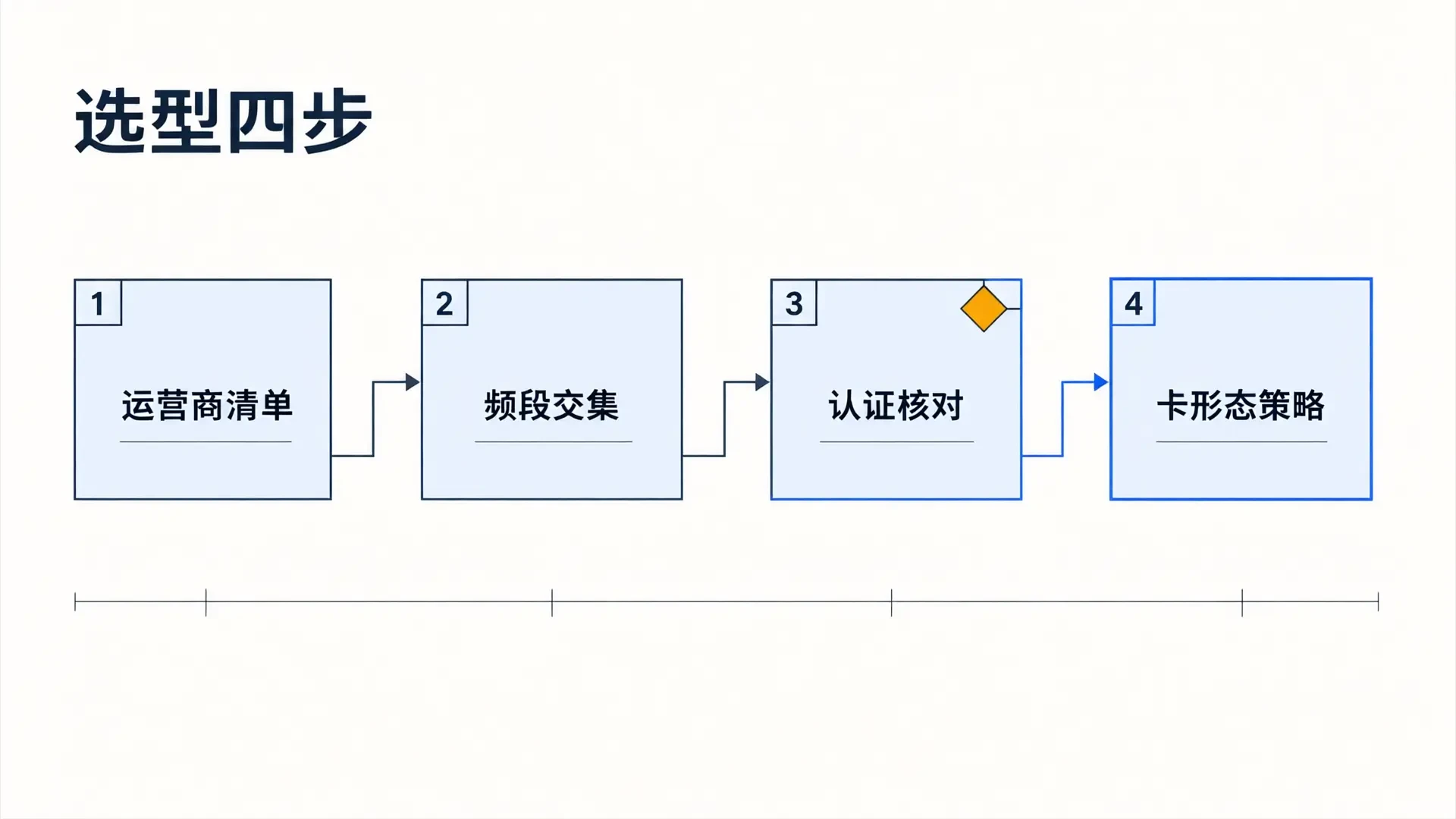
Step 1: Pinpoint the target country to the specific carrier level, rather than stopping at the country level. Frequency combinations can vary significantly across carriers within the same country; matching by country alone risks leaving coverage gaps.
Step 2: Perform intersection to align the operator's active frequency bands with the module's RF capabilities. If the intersection is empty or covers only a single band, the device's reconnection probability will increase in weak signal environments.
Step 3: Verify certification. The EU CE, North American FCC, and carrier access tests have independent requirements. Missing certifications will prevent devices from accessing the network, regardless of frequency band support.
Step 4: Define SIM form factor and network strategy. Cross-border devices typically use international IoT SIMs with automatic multi-network switching to maintain connectivity when local network quality fluctuates. For compact terminals where the SIM is non-removable, eSIM enables remote provisioning via OTA updates, reducing on-site maintenance costs.
Two common pitfalls to avoid
Do not treat the number of bands as a measure of RF performance. Supporting more bands requires additional filtering and switching, increasing both cost and power consumption. IoT devices should be optimized for the few bands actually used at their destination, rather than maximizing the list length.
Ignore network selection during roaming. In international roaming, device network selection relies on SIM-side policies and local agreements; band compatibility only addresses physical layer issues, while service-layer connectivity must be verified through actual testing.
Frequency band verification is often the most skipped step in the selection process and the first issue to surface at overseas sites. Microsecond IoT's international SIM cards cover over 200 countries and regions, supporting multi-network auto-switching and unified management. Our eSIM solution enables OTA card provisioning. For cross-border device projects, we provide frequency matching recommendations based on destination carrier lists, with our technical team available 7×24 hours a day to address on-site issues.