How to Choose Between NB-IoT and Cat.1: Comparison Table
Compare key parameters of NB-IoT and Cat.1 in a side-by-side table, and add the hidden dimension of network ecosystem. Use data volume, latency, and power supply as the three guiding questions for selection recommendations.
For low-rate IoT, the debate centers on NB-IoT vs. Cat.1. Laying out key parameters in a single table makes the choice clear.
I. Comparison Table
The key distinction lies in data volume and latency: NB-IoT is designed for small data payloads and long battery life, while Cat.1 targets mid-speed interactions. Key parameter comparison follows:
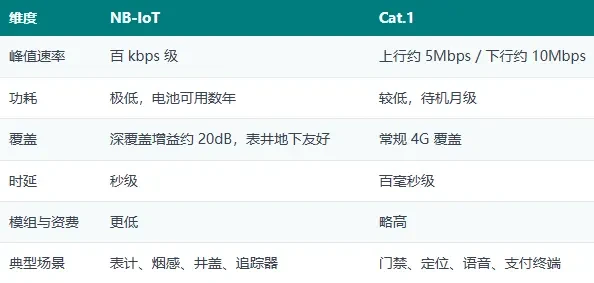
Beyond the table, there's a hidden dimension: network ecosystem. NB-IoT relies on operators' continued investment in and local coverage of NB-IoT base stations; some areas are seeing network shrinkage. Cat.1 is built on mature 4G networks, with coverage following 4G expansion. Before selecting a technology, assess the local network conditions firsthand—don't rely solely on spec sheets.
Two or Three Lessons Learned
For specific projects, follow these three questions:
Check data volumeSuitable for NB-IoT: reporting intervals of minutes or longer, with single payloads in KB range.
Check latencyFor interactions, instant replies, and voice support, just Cat.1.
Check power supplyFor sites with high battery replacement costs, increase the weight on power consumption.
There is no inherent superiority or inferiority in network types. Once you clarify the three key variables—data volume, latency, and power supply—the right choice becomes clear.